2026 Benchmarking Report: Top Technology Trends in Fuel Delivery
You Already Have the Tech. How Well Are You Using It?
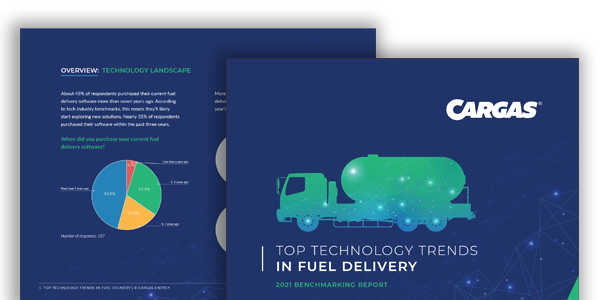
Welcome to the 2026 Top Technology Trends in Fuel Delivery Benchmarking Report, brought to you by Cargas. Results from our seventh annual Tech Trends Survey are in, and we’re excited to share the findings with you.

Tech Trends Benchmarking Report
We surveyed more than 100 fuel dealers to learn how they’re using these tools to support their businesses. How does your company measure up?
Technology is Taking Over
Fuel dealers making good use of the technology available to them are pulling ahead of the competition and seeing new levels of growth.
We’ve identified 7 technological trends that are impacting fuel delivery today. Many of these products and strategies have already been adopted by leaders in the industry. And they’re experiencing growth as other fuel dealers adopt them at an accelerating rate. These technologies offer fuel dealers a competitive advantage, follow global trends, and improve the customer experience.
Here are the leading technology trends in fuel delivery.
Sale & Marketing Tools
Good service and competitive pricing are no longer enough to ensure customer loyalty. Fuel dealers are getting proactive about customer retention, using a variety of technology to stay connected with existing and prospective buyers. They’re also making an effort to meet consumers where they are with a strong online presence and mobile-friendly options.
Because most fuel delivery systems don’t have sales or marketing components built in, many fuel dealers are investing in sales and marketing tools like CRM (customer relationship management) software or marketing automation to manage and improve their sales and marketing initiatives.
The Benefits of Sales & Marketing Software
Central tracking system. CRM software gives your team one place to capture sales opportunities so you never lose track of a potential sale. CSRs can enter information about inquiries they receive over the phone. And drivers and techs can enter sales opportunities they notice when they’re out on a call, like a water heater or a tank that needs to be replaced soon.
Cross-sell and upsell opportunities. By integrating CRM software with your operational system, your sales teams can use existing customer data from your fuel delivery software to identify cross-sell or upsell opportunities. They can search for customers who had equipment installed more than 5 years ago. Or for fuel delivery customers who don’t have service contracts. These sales opportunities can then be entered and tracked in the CRM software.
Manage and track interactions. CRM software helps you keep track of every interaction you have with a customer or a prospective buyer, including emails and phone calls. And it helps you keep the conversation going by creating follow-up tasks and reminders. By keeping all of your conversations in one place, it helps you understand where a customer is in the buying process and how you can move a new sale forward.
Maintain regular communication. Marketing or email automation tools help you stay in front of your customers on a regular basis or nurture prospective buyers. Your marketing team can also combine the information in your fuel delivery software with marketing automation to develop targeted marketing campaigns. For example, you might offer a loyalty discount for longtime customers.
Attract new customers. Consumers primarily interact with businesses online, so providing online and mobile experiences will help customers find you and buy from you. Mobile-friendly websites and social media platforms can be just as important for marketing your business as other forms of advertising.
Summary
Sales and marketing tools like CRM software, email automation, and mobile-friendly websites can help fuel dealers to get better results from their sales and marketing efforts. Energy companies successfully using these tools are better at retaining customers, getting the most out of their existing customer pool, and more accurately identifying and pursuing new opportunities.

Customer Experience Tools
Today, apps are available for everything from banking to healthcare to made-to-order food. Receipts, bills, and invoices are delivered directly to our inboxes. And with automated bill pay, we never have to think about writing or mailing a check.
Today’s consumers are accustomed to looking up information, paying bills, and scheduling appointments on their own. And they expect businesses to give them the option to do so. Companies who don’t offer services like an app, text or email notifications, or a web portal stand out—and not in a good way.
Self-service options like online ordering or bill pay improve customer satisfaction. They also reduce your call volume while improving your cash flow and order volume.
It’s important to understand that a website or a customer portal does not eliminate the need for outstanding personal service. When customers need help, they still want to connect with a person. What’s important is providing both options so your customers can get exactly the type of help they need exactly when they need it.
The Impact of E-Commerce
Beyond apps and web portals, e-commerce has changed the way we buy things. Sites like Amazon and Booking.com eliminate the need to visit retail stores or deal with service providers directly. And consolidated review sites like Yelp and Angie’s List can influence customers before they ever interact with a business.
It’s possible to provide an e-commerce experience in the energy industry by allowing customers to order fuel or schedule service appointments through your website or customer portal.
Summary
Consumer expectations can’t be ignored. By evolving to meet the preferences of a new generation of consumers, fuel dealers can improve customer satisfaction, keep customers engaged, reduce call volume, and improve cash flow and order volume.
Tank Monitors
As an alternative to physically reading gauges on hundreds or thousands of customer tanks, fuel dealers estimate tank levels using K-factors and degree days. But nothing beats exact level readings. And with the internet of things, today’s fuel dealers can have them.
The internet of things (IoT) is a collection of devices linked together with a wireless data or internet connection, like a smart thermostat and your smartphone. Today’s tank monitors are also IoT devices. Using wireless data networks, they can transmit tank readings to other places, like your fuel delivery software. This means fuel dealers can see the exact level of every customer tank.
Why Tank Monitors Now?
Having exact level readings for every tank seems ideal. So why aren’t tank monitors everywhere?
When monitors were hundreds of dollars apiece, outfitting even a few tanks was costly. And the monitors themselves were not very reliable or long-lasting. But tank monitors have come a long way in the last 5 or 10 years. Today, they offer more advanced technology and more durability, all at a much lower price. And fuel delivery companies are adopting them faster than ever before.
Summary
Companies taking advantage of tank monitors have an edge over the competition now. But as prices continue to drop and the technology continues to improve, there’s no doubt tank monitors will become standard for many businesses in the industry.
Mobile Technology
We’re not talking about the mobile fuel delivery systems of 15 years ago (expensive to deploy and clunky to operate). We’re talking about modern mobile devices and applications—technology that looks and acts just like your personal smartphone or tablet.
What makes today’s mobile technology different than the mobile solutions of the past is real-time information flow. Today’s mobile devices can instantly send information to or receive information from your fuel delivery software using cellular networks. There’s no need to plug the device into a server to exchange data.
The Benefits of Today’s Mobile Technology
With this instant, wireless exchange of data, dispatchers can send routes directly to drivers’ mobile devices and make changes on the fly, like adding an emergency will-call stop. And executives can make price changes as often as necessary to maintain margins. With real-time mobile, this information is transmitted from the back-office software to all mobile devices instantly.
And the mobile devices can also instantly transmit information to the back office. When a driver marks a delivery as completed on his mobile device, the dispatcher sees it immediately in the back office.
Why Mobile Now?
Mobile devices have improved along with mobile technology. In the past, rugged tablets for fuel delivery were hundreds of dollars apiece, and outfitting an entire fleet was often too expensive. Today, Android devices are available at a fraction of the cost of their more rugged counterparts.
Not only are Android devices a more appealing investment for today’s energy companies, but Android is also the preferred platform for mobile devices, offering the best connectivity available.
Summary
With the price barrier eliminated by affordable Android devices, fuel dealers using mobile applications in conjunction with their back-office software are jumping ahead of the competition, able to respond to customer needs and changing prices faster than ever before.

The Cloud
The cloud is largely responsible for our always-on, always-connected world. Cloud programs and mobile applications like Facebook, Gmail, and iCloud allow us to plug in anytime, anywhere, from any device.
And the shift isn’t just in our personal lives. In business, today’s teams want the same level of access to the programs they use for work as they have to their Instagram accounts. Just like cloud applications for consumers, cloud software for business offers companies the access and flexibility they expect.
Benefits of Cloud Software
Instant access and flexibility. On-premise software can’t provide the instant, 24/7 access of cloud software. While VPN (virtual private network) is an option, it’s not as fast or easy as using a web browser or an app to access a program. With cloud software, employees can work anywhere, anytime, from any device. Teams can adopt unconventional schedules, work from home or on the road, and manage staff emergencies or extended absences like maternity leave.
Real-time information. Data is processed through cloud software instantly, so all information is available in real time. For fuel dealers, this means updating routes while drivers are on the road, or updating prices throughout the day to maintain margins. For executives, it means immediate access to the information they need to make knowledgeable business decisions.
Reduced IT costs and enhanced security. With no hardware requirements, companies using cloud software don’t need to purchase, maintain, and upgrade on-premise servers. Additionally, businesses offering cloud-hosting services invest more in security than most individual companies would ever be capable of, with safeguards like continuous backups and disaster recovery plans.
Summary
Cloud software is faster, more flexible, more secure, and less expensive than on-premise solutions. Fuel delivery companies adopting it are gaining an advantage over competitors who are limited by slower-moving systems.

Business Intelligence
In a competitive environment, one bad decision can have a major impact. Today’s executives need timely, accurate data so they can make strategic business decisions with confidence.
While fuel delivery software captures loads of helpful information, it’s not always easy to get the information out of the system in a usable format. Instead, fuel dealers are adopting cloud-based business intelligence tools to collect and analyze data from their operating software.
Business intelligence tools provide the reports and dashboards companies need to understand their performance and track goals. Fuel delivery companies can evaluate metrics like driver efficiency; profitability by fuel type, service contract type, division, or location; average gallons delivered per mile; outstanding accounts receivable; and customer source (website, referral, etc.).
Information at Your Fingertips
What makes business intelligence tools so valuable is the speed at which they can deliver this information. You may be able to create a report on your own, but it might take you several hours or days to build it. Today’s executives can’t wait that long for information to be collected—they need it at their fingertips.
Today’s business intelligence tools are moving to the cloud so they are always available with up-to-the-minute information. Once a report or dashboard is built in a business intelligence tool, the information is automatically updated any time new data is entered into your fuel delivery software. This means you’re always looking at the most recent figures. Cloud BI tools can even be set up to email reports or analytics to you on a set schedule.
Often, the data is presented in a visual format that makes it quick and easy to digest. Instead of reading through rows of numbers and trying to make sense of what they mean, business intelligence gives you a clear picture with charts and graphs that help you understand the information at a glance.
Summary
Fuel dealers are turning to BI solutions to understand their performance better and make informed decisions. With key metrics at their fingertips, executives can separate their businesses from the competition by making strategic decisions faster.

Cybersecurity
As we’ve become more and more tech driven, data security and privacy are top of mind for individuals and businesses alike. Just as technology is evolving, so are viruses, malware, and hackers.
Tech companies like Google and Facebook are under fire for their questionable use of consumer data. And legislation like GDPR points to a growing desire to better protect our personal information online.
In this climate, cybersecurity is more of a necessity than a trend, especially for businesses like energy companies that manage their customers’ personal information in addition to their own.
Many fuel dealers are adding IT staff so they have a dedicated resource to establish and manage their cybersecurity needs. Besides building up internal IT resources, fuel dealers are also turning to Managed Security Service Providers (MSSPs) for threat and vulnerability management and incident response.
Cybersecurity Best Practices
Cybersecurity best practices for businesses include:
- Using a firewall
- Securing your wifi network
- Securing connected internet of things (IoT) devices and your team’s personal devices
- Using antivirus and malware detection programs
- Following safe password practices
- Using multi-factor authentication
- Regular system checks and data backups
- Documenting and maintaining security policies
Additional security measures might include a regular review of who has access to your data to remove former and seasonal employees, consultants, or interns; monitoring users with the highest levels of data access; and even biometric security, like voice or fingerprint recognition.
Employee education is also becoming a critical component of cybersecurity. No matter how good your security systems are, human error can give hackers access to your network and data through phishing emails or unsecured personal devices.
Everyone with access to your data has an impact on its security. So it’s important to give your team the tools they need to identify and avoid security threats.
Summary
If you don’t have the necessary protocols in place, a data breach can bring your business to a standstill and damage your relationship with your customers.

The Impact of COVID-19
As essential businesses, fuel dealers have been challenged with maintaining operations during a global pandemic while looking out for the health and safety of their employees and their customers. Operating in these conditions meant adapting to new working practices and relying on technology more than ever before. In many cases, the pandemic accelerated the trends covered here as fuel dealers added new technology to support new ways of working.
The pandemic emphasized the value of cloud- and web-based tools to support remote work. Tools to provide contactless, paperless transactions like online ordering, online bill pay, and more also became critical. Across industries, businesses have invested in communication tools like video conferencing and chat.
IT and cybersecurity needs have also changed because of the pandemic. Fuel dealers had to evaluate their infrastructure, hardware, and cybersecurity needs to allow easy remote access to operational systems while keeping data protected.
Summary
The COVID-19 pandemic emphasized technology weak spots for some businesses. At the same time, those with cloud- or web-based software, tools to support electronic or contactless transactions, and the infrastructure to support remote work were able to adapt quickly to new and changing circumstances.

Future Projections
Technology continues to change rapidly, and the relevant advancements will certainly have an impact on fuel delivery. While the details may not be completely clear, technology will continue to play a larger and larger role in the energy industry moving forward. Here are some things to keep an eye on.
Paperless offices and remote workforces. We identified these as future projections last year and believe they have been accelerated by the COVID-19 pandemic. The pandemic has pushed many businesses to adapt to support remote employees and electronic versus paper transactions.
Energy e-commerce. E-commerce sites like Amazon set the bar for consumer expectations. And with the 2020 pandemic, many businesses offer online ordering, from major retailers like Walmart to locally-owned small businesses. Providing e-commerce options for fuel delivery and HVAC service will become a critical component of satisfying customers moving forward.
Tech for CSRs. The industry is transitioning to serve consumers who primarily interact with businesses online or through mobile devices. As it does, it will become increasingly important to equip your customer service team with technology that allows them to interact with customers where they are. This could mean relying more heavily on text, chat, email, or social media rather than phone calls to communicate with customers.
Social media. Social media has made the leap from personal to business. Companies can use social platforms to get their products in front of consumers and share content. Customers interact with businesses on social media and share feedback through reviews and comments. As the line between business and personal blurs, social media accounts may be just as important as websites for businesses like fuel delivery companies in a B2C industry.
Customer review monitoring. Reviews can influence potential buyers before they even interact with your business. While most fuel dealers monitor customer reviews on a handful of sites or platforms, there are endless ways for customers to leave feedback about your business online. Mid-market and large energy companies may benefit from a review monitoring tool that makes it easier to track business ratings across multiple sites.
What It All Means
Technology trends in business typically follow what’s happening in our personal lives. Universally, we’re looking for our experiences to be the same across the different facets of home and work. Fuel dealers can look to their personal use of technology to identify the expectations of their customers.
Technology offers a way for fuel dealers to get ahead in a competitive marketplace. Forward-thinking companies recognize this as an opportunity—a way to open the door to new possibilities and new levels of success. But that doesn’t mean every tool or trend makes sense for every business. It’s important for fuel dealers to be aware of the industry trends and continually evaluate whether or not they should play a part in their company’s ongoing strategy.
How will you use technology to support your business moving forward?
Tech Trends Benchmarking Report ►